Nakamichi Recital Series: Area 9
This saxophone quartet will perform music by Michael Nyman, William Grant Still and Antonin Dvorak.
About the Performers
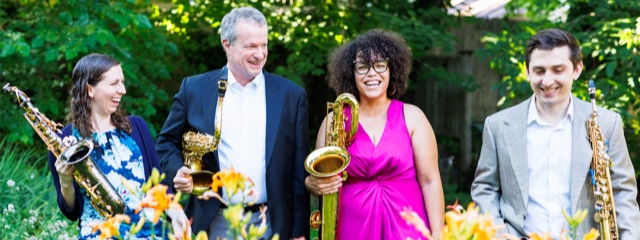
Area 9, a Boston-based saxophone quartet, brings a highly dynamic and diverse program to the stage. Their performance bridges the gap between historical eras and modern classical innovations by showcasing how the uniquely expressive voice of a saxophone quartet can transform a wide variety of musical traditions. Members of Area 9 include:
- Sean Mix: Soprano Saxophone
- Cara Hachten: Alto Saxophone
- John Rabinowitz: Tenor Saxophone
- Seychelle Dunn-Corbin: Bari Saxophone
Behind the Music
Below, you will find information about the performers and musical works that inspired the selections featured in this recital.
Michael Nyman had already begun writing a saxophone quartet when he learned his longtime business manager, Tony Simmons, had passed away in January of 1993. In the aftermath of Simmons’ death, Nyman scrapped his previously written material and began to write Songs for Tony using a combination of new material and arrangements of previous compositions. Each movement features a different player in what Nyman describes as an "aria," with the other three voices playing accompanying roles.
The first movement is an arrangement of Nyman’s Mozart on Mortality (1992), a song for soprano voice and chamber ensemble. The text is from a letter written by Wolfgang Amadeus Mozart to his father Leopold Mozart, written shortly before Leopold’s death in 1787:
I have now made a habit of being prepared in all affairs of life for the worst.
As death is the true goal of our existence, I have formed these last years such close relations with this best and truest friend of mankind that his image is no longer terrifying to me, but is very soothing and consoling!
And I thank my God for graciously granting me the opportunity of learning that death
is the key which unlocks the door to our true happiness.
I never lie down at night without reflecting that young as I am, I may not see another day.
Movement two features themes borrowed from Nyman’s score to the 1993 film The Piano, which was the final deal Simmons had negotiated for Nyman before his passing.
Movements three and four replace the alto saxophone with a second baritone saxophone, giving the ensemble a darker sound. Unlike the earlier movements, these are not borrowed from Nyman’s other published works. The third, in which the soprano voice is featured, is "based on a tune I composed some years ago but was saving for a special occasion." The fourth, featuring baritone saxophone, was composed in the immediate aftermath of Simmons’s death
William Grant Still's remarkable composition, also known as the Lyric String Quartette or Musical Portraits of Three Friends, stands as a testament to his artistry and deep friendships. Dedicated to his friend, the talented violinist Joachim Chassman, this work reflects Still's thoughtful process, with the original manuscript showcasing alternative titles and diverse movement names he contemplated in earlier drafts. Although he began this captivating piece between 1939 and 1945, it wasn't until 1960 that he fully realized his vision.
Still's composition comprises three movements, each crafted to encapsulate the essence of friendship. The first movement, "The Sentimental One," subtitled "Moderately – On a Plantation," offers a serene and inviting melody that beautifully showcases the quartet's rich timbres. Throughout this movement, the ensemble unites to create a seamless sound, resulting in what can only be described as musical ripples. The word ‘sentimental’ evokes feelings of tenderness, sadness, and nostalgia, and Still masterfully channels these emotions in the opening movement. By avoiding dramatic fluctuations and embracing a familiar, warm style, he accentuates the nostalgic and tender qualities tied to this friendship, illustrating the profound influence it had on the composer.
Movement II, titled "The Quiet One," subtitled "Moderately Slow – In the Mountains of Peru," introduces a beautifully gentle and reflective melody, which the score notes is “Based on an Inca Melody.” In this movement, Still artfully holds back the full expression of the melody, embodying the essence of a quiet friend. This deep introspection and personal touch in "The Quiet One" not only highlights Still’s remarkable skill but also demonstrates his growth as a composer.
Movement III, titled "The Jovial One," also known as "Moderately Fast – In a Pioneer Settlement," bursts with energy and excitement, creating a loud and boisterous atmosphere that draws listeners in. This movement stands out as the most vibrant and driven of the three, instantly establishing its joyful character. The lively, bouncy melody, prominently led by the upper saxophones, builds up to an exhilarating finale, bringing all the musical elements together in a captivating climax.
From 1892 to 1895, Czech composer Antonin Dvorak held the position of director of the National Conservatory of Music of America, on East 17th Street in New York City. During his tenure, he wrote his most celebrated symphony, #9, “From the New World”, a major Cello Concerto, as well as his “American” String Quartet in F Major, composed in 16 days while on holiday with his family in the town of Spillville, Iowa in the summer of 1893.
His adopted American environ proved inspirational in myriad ways. The third movement of the Quartet features an evocation of birdsong in the highest voice, which recent scholarship has identified as the call of the Red-eyed Vireo, heard by Dvorak on his daily walks in the Spillville woods. And while Dvorak demurred from acknowledging specific musical influences in the Quartet, many listeners have discerned echoes of an African-American spiritual or a Native American chant in the principal melody of the “Lento” second movement. What is certain is that Dvorak made public his admiration for both musical traditions: in his capacity as a conservatory director, he penned several articles for New York newspapers calling for 20th century American music to be founded upon these and other indigenous folk idioms.
The event is free and open to the public and is sponsored by the Department of Visual & Performing Arts.