From Taylor Swift to the White House
An economics major offers a fascinating opportunity to use data to understand human behavior and how we respond to incentives.
How are Taylor Swift concert tickets and local inflation rates connected? They’re both examples of how demand can drive prices in ways that ripple across an economy.
Economists like Sam Neil ’20 study these patterns every day.
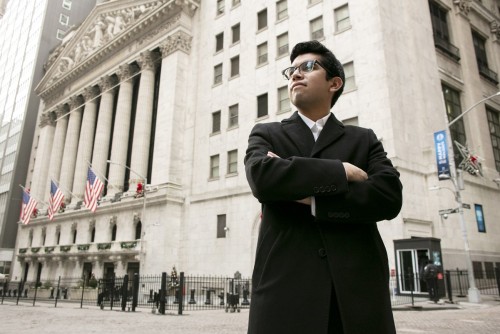
Neil, who majored in economics and criminology at Stonehill, is an industry analyst for the U.S. Bureau of Labor Statistics, focusing on the food and energy industries.
“I sample data from companies within a specific industry, which we aggregate to represent the industry as a whole,” says Neil, whose expertise is in the Producer Price Index, which measures economic activity between companies rather than consumers.
While it may sound theoretical, this kind of analysis has real-world effects most people don’t recognize.
For example, Neil’s research helps companies set contract pricing for products, which directly affects the prices consumers pay. It’s also a data source cited by national news outlets like The New York Times and The Washington Post, shaping how the public understands economic trends.
At a broader level, his work has even reached the White House, helping inform National Economic Council discussions on national and global policy.
According to Neil, his Stonehill education is far more than just a credential on his resume.
“I get to see how the concepts I learned as an undergrad are directly applied in the real world,” he said. “It’s very rewarding to see that it really does matter.”
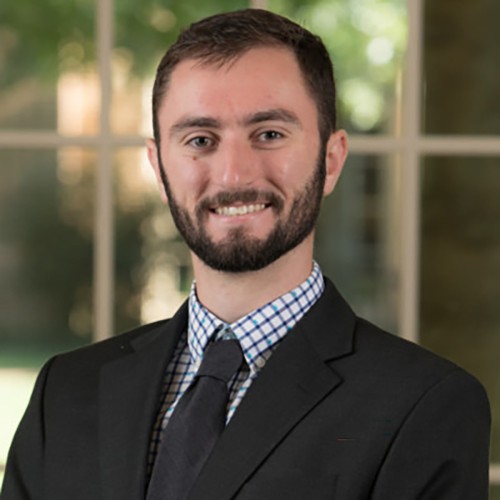
One of the biggest benefits of my degree is that it taught me how to look at a micro issue, but also understand how it can become a macro issue that impacts the rest of the organization.
Expertise That Helps Organizations Solve Problems
Stonehill economics alums are well represented in a wide range of industries beyond the federal government. Steve Bomba ’17 works at Boston Beer Company as a senior business analyst.
In this role, Bomba’s work often begins with small problems. A shipment shows up late. A product is listed as available in one system but not another. A report no longer reflects how a team actually works.
Bomba is often the person asked to figure out why.
“My work is about finding relationships between different data sources,” said Bomba, who paired his economics degree with a second major in psychology. “I collaborate with teams across the company that have vastly different responsibilities.”
By making sure data is accurate and consistent, Bomba is helping teams across the company do their jobs more efficiently. The work also lays the groundwork for the organization to implement AI tools, which require reliable information to be useful.
Bomba says the way he learned to think at Stonehill still guides how he approaches his work today.
“One of the biggest benefits of my degree is that it taught me how to look at a micro issue, but also understand how it can become a macro issue that impacts the rest of the organization,” he said.
The day-to-day responsibilities of his role aren’t all that Bomba enjoys about working at the Boston Beer Company.
“The company has a fantastic culture,” he said. “It’s a place where you’re not afraid to speak up, whether you’re in a room with an analyst or the CFO. If you have an idea, you can make a difference, at any level of the organization.”
A Skill Set Highly Valued by Global Organizations
At New Balance, Stonehill alum Isabel Baker ’19 is building her career focusing on how business systems function in a global organization. The senior business analyst, who double-majored in economics and marketing, is part of the team that designs and implements large-scale business systems.
New Balance’s global footprint is an important factor that defines her work. Baker frequently collaborates with international colleagues to build systems that work for employees located across the world. For example, a single decision might need to account for how teams operate in North America, Europe and Asia — all within the same system.
“I have to understand the nuances of each region and their needs to make the system work globally,” Baker said. “They all have to be aligned before we can build the system.”
Baker’s work rarely looks the same from week to week. Depending on the project’s phase, she might be interviewing colleagues about their current processes, leading design workshops, working with developers on technical requirements, testing systems after launch or organizing training.
“The most rewarding part is going live and seeing how processes improve,” she said. “The old system may have been in place for 10 or 15 years, so when we replace it, people are really excited to use it.”
Like Bomba, it’s not just the role that Baker enjoys — it’s the company as well.
“I love New Balance as a company,” she said. “They do a great job of hiring people aligned with the company’s culture and values. Some of my co-workers drive all the way from Rhode Island and New Hampshire to work here in Boston. It just shows what a great place New Balance is.”
Piyush Chandra is a professor of economics and chair of the Economics Department.
“We don’t teach students a single set of skills,” he said. “We give them tools they can use in any career.”
Chandra said many students don’t appreciate economics until they’ve taken a course.
“Most of our students don’t come to campus wanting to become an economist,” said Chandra, whose fields of specialization are international trade, political economy of trade policy and industrial organization. “They don’t know all that the degree has to offer. But after they take their first class, they realize the lessons they are learning are applicable everywhere.”
Recent Outcomes











Related Links
-
Economics Major
Economics majors at Stonehill explore decision making and its consequences in markets and entire economies.
-
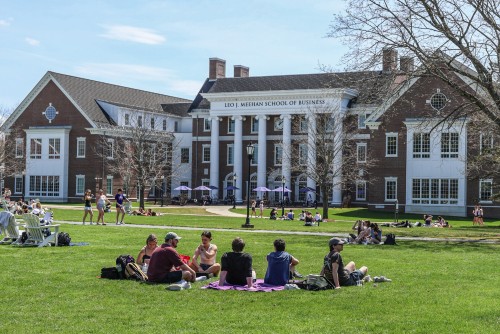
Meehan School of Business
The Meehan School of Business empowers students to be adaptive, compassionate leaders in the fields of business, economics and healthcare management.
-
Plan Your Visit
Our visit programs will help give you a better understanding of how Stonehill’s expansive leadership and experiential learning opportunities equip students for success in a rapidly evolving and globally competitive world.