
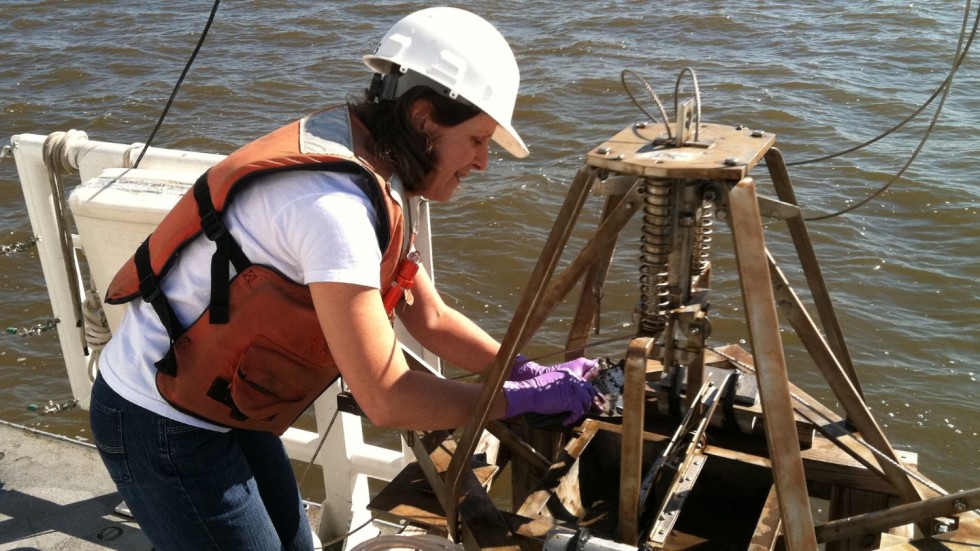
Elizabeth Canuel '81 conducts research on the Delaware Bay.
Five Questions with Elizabeth Canuel '81
A chemical oceanographer’s journey of learning and leadership.
Stonehill College offered Elizabeth Canuel, Ph.D. ’81 exactly what she was seeking as an undergraduate: a close‑knit community that encouraged curiosity and exploration. The College’s small classes and accessible faculty helped the chemistry major discover her strengths and pursue a wide range of interests, from campus activities to early research experiences.
After Commencement, a position at the Woods Hole Oceanographic Institution sparked her “aha” moment, revealing the connection between chemistry and the marine world that would define Canuel’s career. Building upon her deep connection to the ocean and the strong scientific foundation she gained at Stonehill, she went on to earn a Ph.D. in marine science from the University of North Carolina at Chapel Hill. She then spent 28 years teaching at the Virginia Institute of Marine Science/William & Mary, earning the title of chancellor professor and upon retirement was named chancellor professor emeritus. Today, she continues shaping the field in her work with the National Science Foundation.
Amid her scientific achievements, her mentors and memories from Stonehill have remained touchstones. The recipient of the 2020 Outstanding Alumnus Award and now serving on the College’s Board of Trustees, she is grateful to give back to the community that launched her journey. In five questions, Canuel reflects on classes with Professors Chet Raymo and Louise Hegarty, the educational programs she helped build, and the future she envisions for marine science and for Stonehill.
Reflecting on your time at Stonehill, was there a particular mentor, experience or memory that shaped your approach to teaching and working with students?
I was inspired by the work of Chet Raymo, professor emeritus of physics and a well-known writer, who recently passed away. He introduced me to the vastness and wonder of nature. I have tried to carry his passion for the cosmos to my lectures on the oceans, teaching students how the ocean remains one of the remaining frontiers of discovery on earth. Another source of admiration was Professor Louise Hegarty, who helped me rediscover my love of math after several difficult semesters of calculus. Both professors inspired me to face challenges gracefully, and I have tried to be supportive, compassionate and encouraging to students when they face challenges and setbacks.
During your 28 years at the Virginia Institute of Marine Science/William & Mary, you made lasting contributions as a researcher, educator and program leader. Looking back, which accomplishments are you most proud of and why?
Overall, I’m most proud of all the students I’ve taught and advised over the years, and it brings me joy to see them advancing in their own careers in very individual ways.
There are two very special accomplishments that come to mind. The first is establishing the Female Introduction to Research Science & Technology (FIRST) program at the Virginia Institute of Marine Science/William & Mary. This program paired individual high school girls with two women mentors—a graduate student and a faculty member—during a summer internship at the Virginia Institute of Marine Science. The idea was to provide role models for high school girls interested in science and to give them a “real world” experience of working in a research setting. Since I had encountered very few women during my own academic journey, I thought it was important to give girls an opportunity to experience hands-on science and to meet women at a variety of career stages who could serve as role models and mentors.
A second accomplishment I am proud of is my role in establishing an undergraduate minor in marine science at William & Mary. As the co-leader/director of the marine science undergraduate program for 10 years, my goal was to encourage students to pursue a career in marine sciences as well as provide marine science training to students who were pursuing degrees in fields we don’t typically associate with marine science.
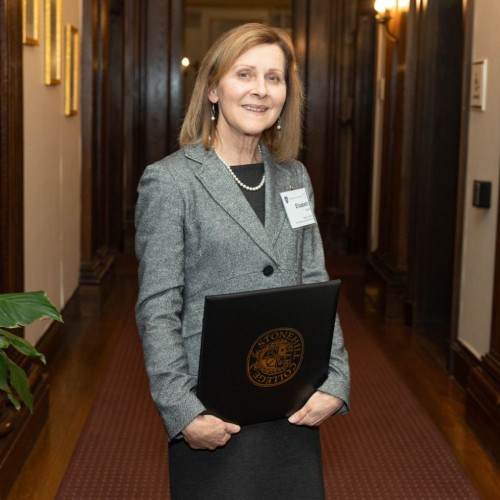
I also hope to contribute ideas to enhance and develop Stonehill’s strengths as a community of learning that provides growth opportunities for the entire campus—students, faculty and staff.
You’ve held leadership roles across major scientific organizations. What do you see as the most important opportunities and challenges facing marine science today?
The most important current challenge facing marine sciences today is understanding and anticipating how the oceans are changing and how these changes will affect both the marine ecosystem as well as human health and well-being. Opportunities lie in the advancement of new tools and research that will allow us to monitor the ocean remotely and in real-time through satellites and sensors. In addition, we need to consider new ways to train and expand the ocean science workforce so that we have the necessary skills to analyze “big data,” utilize artificial intelligence and machine learning in ethical and appropriate ways, expand modeling and simulation science, and develop new technologies in areas such as robotics and biotechnology.
With research spanning decades and more than 100 peer-reviewed publications, what skills or perspectives do you think are most important for students entering marine science or chemical oceanography to develop today?
Strong communication skills are essential for all students but are especially important for scientists who must communicate complex information to broad audiences that include fellow scientists as well as policymakers and the public. Many of us become scientists because we are curious about how the world works, and there is a perception that being a scientist means working in a lab, or in my case, going out to sea on a research cruise. As a senior scientist, I spent much of my time communicating science both through my writing and public speaking. In addition to strong technical and quantitative skills, a successful scientist in the modern world needs a large “toolbox” of communication expertise, including effective use of social media and marketing skills.
President John Denning, C.S.C., presents Elizabeth Canuel ’81 with the 2020 Outstanding Alumnus Award for her stellar career in science.
As a Stonehill alumna and current member of the Board of Trustees, what does it mean to you to give back to the institution that helped launch your academic journey?
It’s an honor and a privilege to serve Stonehill as a member of the Board of Trustees, and I’m happy to “give back” in whatever ways best serve the College. I joined the Board during Summer 2025, so I’m still in the process of rediscovering the campus, understanding its position in the current higher education landscape and figuring out how best to contribute. I hope my experience as a faculty member at a research university will be useful as Stonehill considers new opportunities such as the nursing program and ways to grow its graduate programs. I also hope to contribute ideas to enhance and develop Stonehill’s strengths as a community of learning that provides growth opportunities for the entire campus—students, faculty and staff.